Looksmaxxing and Body Dysmorphia: The Warning Signs Parents Miss in Teen Boys
I have been seeing a lot of impressionable young boys being influenced by incel online communities. These ideas are heavily popularized by online creators and influencers such as Braden Peters, known online as Clavicular. I have also seen a lot of the kids I work with get really into their looks. I have had plenty of conversations with them about their looks, and when I ask them about looksmaxxing, they are very aware of it. We have good conversations about looksmaxxing and mental health.
In September 2026, Peters was charged in Massachusetts with raping a 17-year-old girl, drugging her for sex and giving her alcohol. A not guilty plea was entered on his behalf, and his lawyers say the encounter was consensual (Kruesi, 2026).
One thing I would like parents to know is that this is not just a phase that kids grow through. It is something that can leave a deep impression on their self-worth and self-esteem.
Looksmaxxing becomes a warning sign for body dysmorphia when a boy's routine is driven by fear of a flaw, takes over hours of his day, or puts his health at risk.
In this article, I will explain what looksmaxxing is, why it is more than a phase, the body dysmorphia warning signs parents often miss, the physical risks, and how you can help your son.
What Is Looksmaxxing?
Looksmaxxing is an online trend where boys and young men try to "maximize" their looks, and it runs from normal grooming to dangerous self-harm. It spreads through TikTok, YouTube, and Kick livestreams. The trend treats a man's face and body like a score to optimize. The ideal is rigid: a sharp jaw, high cheekbones, perfect symmetry, and a lean, muscular body.
Researchers describe looksmaxxing as a spectrum (Ganson et al., 2026):
"Softmaxxing" covers skincare, haircuts, dental care, sleep and working out. On its own, this is normal self-care.
"Hardmaxxing" covers extreme or unproven methods, like starving for hollow cheeks, illegal steroids, or striking the face to reshape the bones.
The researchers warn against treating every boy who uses skincare or lifts weights as if something is wrong. The concern starts when the behavior becomes extreme, unsafe, or tied to real distress (Ganson et al., 2026).
You may also hear words like "mewing" (pressing the tongue to the roof of the mouth to sharpen the jaw), "mogging" (looking better than someone else) and "ascending" (the belief that better looks will fix your whole life). Many boys also upload selfies to apps or forums that give their face a number score.
Why Looksmaxxing Is Not Just a Phase
Looksmaxxing communities sell self-improvement, but research shows they often teach boys that they are not good enough. One study analyzed more than 8,000 comments on a popular looksmaxxing forum that gets about 6 million visitors a month (Halpin et al., 2025). Boys posted photos and asked for feedback. Instead of help, many were told they were failed men. Some were even encouraged to hurt themselves.
The researchers call this "demoralization." A boy shows up wanting to feel better and leaves believing his face decides his worth. That is a heavy message for a 14-year-old who is still figuring out who he is.
There is another layer. Looksmaxxing overlaps with incel and other online spaces that treat looks as the price of dating, status and respect (Ganson et al., 2026). Some of the loudest voices also spread negative views about women. A boy can start with a skincare video and end up in a worldview that hurts how he sees himself and others.
Timing matters too. Body dysmorphic disorder usually starts in the early teen years, and it usually does not get better on its own (Mayo Clinic Staff, 2022).
From Red Pill to Black Pill
The "black pill" is the most hopeless idea in these spaces, and it is the one parents most need to understand. It grew out of an older idea called the "red pill," named after the movie The Matrix. Red pill thinking claims that men, not women, are the ones without power in society (New America, n.d.). But it still offers a fix: learn the right dating "game," make more money, get in shape.
Around 2016, many incel forums began shifting from the red pill to the black pill (New America, n.d.). The black pill keeps the red pill's view of women but throws out the fix. It says a man's romantic future is locked in by traits he cannot change, like his face, height and genes. If that is true, trying to improve yourself is pointless.
This is where looksmaxxing and the black pill meet. Looksmaxxing promises boys they can "ascend" if they work hard enough on their looks. When the routines do not deliver, the black pill offers a darker answer: you were born a failure, and nothing will change it.
Looksmaxxing and Mental Health: The Body Dysmorphia Warning Signs
The signs of body dysmorphia in boys often look like discipline, so parents miss them. Body dysmorphic disorder (BDD) is a mental health condition where a person cannot stop thinking about a flaw in their looks that others barely notice or cannot see at all (Mayo Clinic Staff, 2022). Here is how some of the common signs can show up in a teen boy who is into looksmaxxing:
Warning sign of body dysmorphia | What it can look like in a teen boy |
|---|---|
Extreme focus on a flaw others can't see or think is minor | He talks constantly about his jawline, eyes or hairline, and you cannot see what he sees |
Strong belief that he is ugly or deformed | He calls himself "subhuman" or "low tier" and means it |
Belief that others notice his looks and judge or mock him | He avoids photos or thinks classmates are rating his face |
Fixing or hiding behaviors that are hard to control | Hours of mirror checking, face exercises or routines he cannot skip without panic |
Constant comparison with others | He uploads selfies to rating apps or compares himself to influencers |
Seeking reassurance about his looks | He keeps asking if he looks okay, or asks strangers online to score him |
Wanting cosmetic fixes that never feel like enough | He pushes for fillers, surgery or online "peptides," and the goal keeps moving |
Avoiding social situations | He skips practice, school or hanging out on days he feels "ugly" |
Signs adapted from Mayo Clinic Staff (2022).
Watch for perfectionism too. A boy who needs every part of his face and body to be "ideal" is under constant pressure.
Muscle dysmorphia is a related concern that shows up mostly in boys and men. It is a type of body dysmorphia where someone believes he is too small or not muscular enough, even when he is not (Nagata et al., 2026). One survey of boys and men ages 15 to 35 found that about 2.8% met the criteria for probable muscle dysmorphia (Ganson et al., 2025). That study recruited people through social media and did not use clinical interviews, so the true number is still being studied. Signs include rigid workout and diet rules, panic about missing a workout, and interest in steroids or other muscle-building drugs.
In my work, I see that boys rarely say "I hate how I look." They say "I am just locked in" or "I am working on myself." The question for parents is not whether he cares about his looks. It is whether his looks are running his life.
The Physical Dangers of Looksmaxxing
Some hardmaxxing methods can cause lasting physical harm, and parents should take them seriously. Researchers who reviewed the trend flagged these practices (Ganson et al., 2026):
Extreme dieting to get a hollow-cheek, "lean" face. This can look a lot like an eating disorder.
"Bonesmashing," where boys hit their cheekbones or jaw with hard objects, hoping the bone grows back wider. There is no good evidence this works, and it can cause injury.
Unsafe at-home treatments, like skin-lightening creams or do-it-yourself cosmetic procedures.
The possible harms include injuries, infections, hormone problems and permanent damage to the face or body (Ganson et al., 2026). Forum users also push surgeries such as nose jobs and leg lengthening (Halpin et al., 2025).
How Parents Can Help Their Teen Boys
The best thing you can do is stay curious and keep him talking. Experts advise against mocking or brushing off a boy's concerns about his looks (Ganson et al., 2026). That usually pushes him back to the forums, where strangers are happy to listen. Here is what tends to work better:
Ask before you advise. Ask what he is watching, who he follows, and what he hopes looksmaxxing will give him. Listen for the feeling underneath, like loneliness or fear of being left out.
Respect the goal, correct the method. Wanting to look and feel better is normal. You can support healthy habits like sleep, skincare and training while gently pushing back on the misinformation.
Teach him how the feed and algorithm work. Explain that photos are edited, "before and after" posts are staged, and apps are built to keep him scrolling and comparing (Ganson et al., 2026).
Shift the focus from looks to strengths. Point out what his body can do and what he is good at, like sports, music, art or being a good friend.
Know when to get help. If his looks take up hours of his day, keep him from school or friends, or lead to risky behavior, it is time to talk with a professional.
Read more: Building Youth Self-Esteem in Teen Athletes
Conclusion: Your Son Is More Than His Looks
Looksmaxxing is not just a trend your son will outgrow; for some boys, it shapes how they see their worth. Most boys who care about their looks are fine. But when the routine is driven by fear, takes over his day, or puts his body at risk, it may be a sign of body dysmorphia, muscle dysmorphia or an eating disorder.
Therapy can be a safe place for a teen boy to talk about what he sees in the mirror without being judged. In my sessions, we also work on self-worth that does not depend on a score, and on the pressures of social media and peers. Therapy works best alongside your son's doctor when there are physical concerns.
If you are a parent in the Sacramento area and you are worried about your son, I would be glad to help. Email me at [email protected] or call 408-345-5293 to schedule a personalized consultation.
If your son talks about hurting himself or not wanting to live, call or text the 988 Suicide & Crisis Lifeline right away, or call 911 in an emergency.
Frequently Asked Questions
Is looksmaxxing bad for teens?
Not all of it. Skincare, good sleep and working out can be healthy. It becomes a problem when a teen feels he is worthless without the "right" face, spends hours on it, or tries risky methods like extreme dieting or bonesmashing.
How do I know if my son has body dysmorphia or just cares about his looks?
Look at how much it costs him. A boy who likes his routine and moves on with his day is usually fine. A boy who panics when he misses it, avoids people, or never feels good enough may need support.
Should I take away my son's phone?
Taking the phone away may cut off the content, but it can also cut off the conversation. Start by talking with him about what he watches and why. Limits work best when he understands the reasons behind them.
About the Author
Kamal Ahmed, LMFT, is a licensed therapist in the Sacramento area specializing in mental health and performance for student athletes and teens.
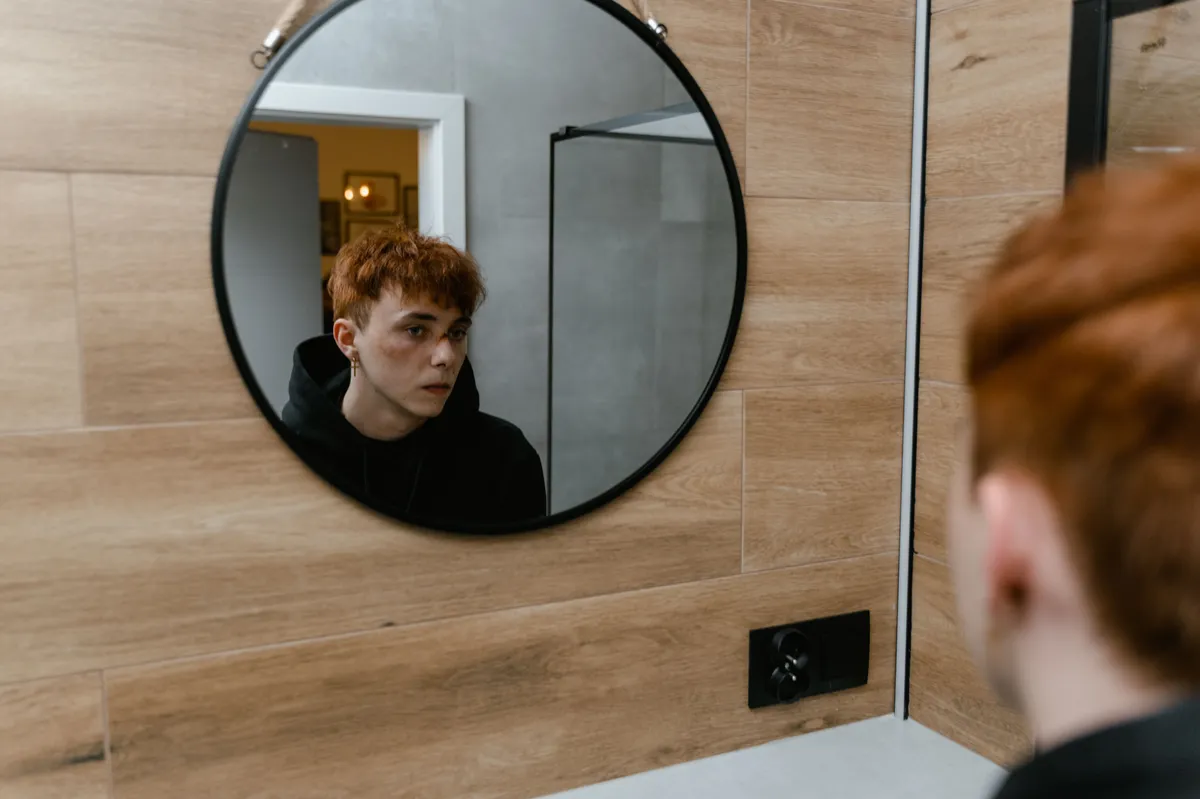
Cover photo by MART PRODUCTION on Pexels
References
Ganson, K. T., Mitchison, D., Rodgers, R. F., Murray, S. B., Testa, A., & Nagata, J. M. (2025). Prevalence and correlates of muscle dysmorphia in a sample of boys and men in Canada and the United States. Journal of Eating Disorders, 13, 47. https://doi.org/10.1186/s40337-025-01233-x
Ganson, K. T., Piatkowski, T., & Nagata, J. M. (2026). Looksmaxxing among adolescent boys and young men: Increasing awareness among clinicians. Journal of Adolescent Health. https://doi.org/10.1016/j.jadohealth.2026.07.034
Halpin, M., Gosse, M., Yeo, K., Handlovsky, I., & Maguire, F. (2025). When help is harm: Health, lookism and self-improvement in the manosphere. Sociology of Health & Illness, 47(3), e70015. https://doi.org/10.1111/1467-9566.70015
Kruesi, K. (2026, October 22). 'Looksmaxxing' streamer known as Clavicular pleads not guilty to rape charge. Associated Press. https://www.ajc.com/news/2026/10/looksmaxxing-streamer-known-as-clavicular-pleads-not-guilty-to-rape-charge/
Mayo Clinic Staff. (2022, December 13). Body dysmorphic disorder: Symptoms and causes. Mayo Clinic. https://www.mayoclinic.org/diseases-conditions/body-dysmorphic-disorder/symptoms-causes/syc-20353938
Nagata, J. M., Hur, J. O., Murakami, K., Ganson, K. T., He, J., Murray, S. B., & Lavender, J. M. (2026). Muscle dysmorphia in adolescents and young adults. The Lancet Child & Adolescent Health, 10(2), 122–134. https://doi.org/10.1016/S2352-4642(25)00283-4
New America. (n.d.). Red pill to black pill. In Misogynist incels and male supremacism. https://www.newamerica.org/insights/misogynist-incels-and-male-supremacism/red-pill-to-black-pill/