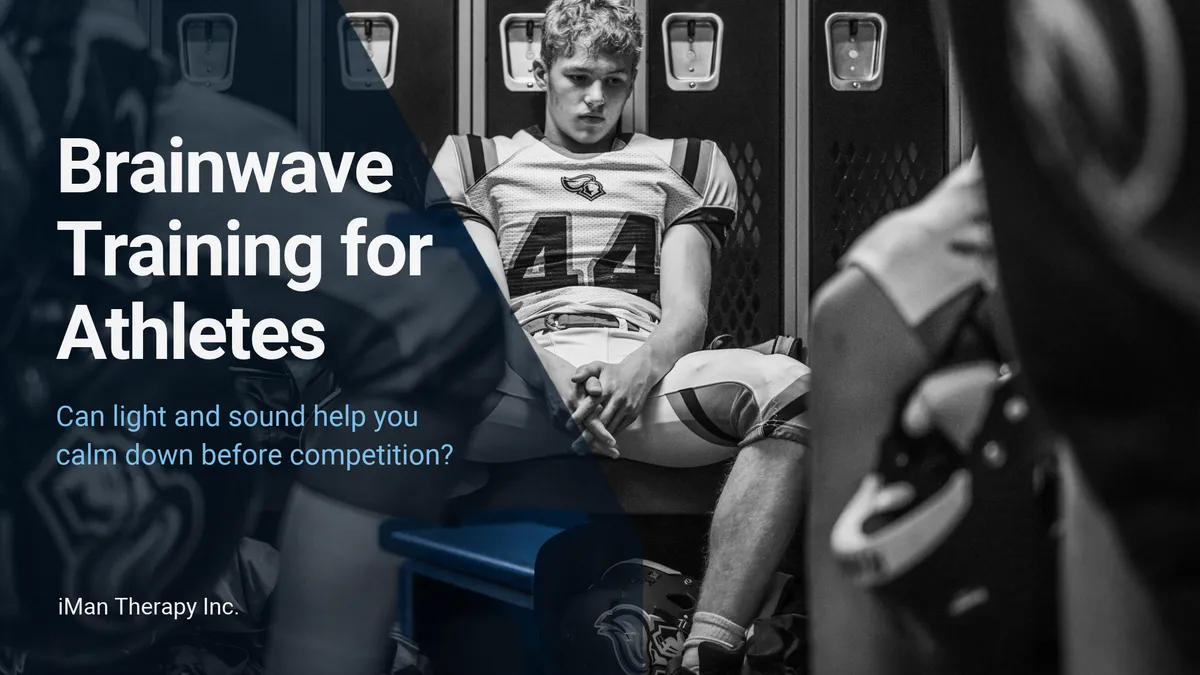
Can Light and Sound Really Calm an Athlete Down?
Yes, for some athletes, light and sound training may help the brain shift into a calmer state before competition. It is not magic. It does not replace practice, coaching, or mental skills work. But it is a real tool, and it is worth understanding.
You know the feeling. It is the night before a big game. Your body is tired, but your brain will not shut off. You replay the same play over and over. Your heart beats fast in the locker room. You tell yourself to relax, and it only gets worse.
That is not weakness. That is a brain stuck in high gear. As a therapist who works with student athletes in the Sacramento area, I see this every week. In this article, you will learn what brainwave training is, how it works, what the research really says, and how an athlete can try it safely.
What Is Brainwave Training?
Brainwave training uses flashing lights and pulsing sounds to gently guide your brain into a chosen state. The full name is audio-visual entrainment, or AVE. "Entrainment" just means your brain starts to match a rhythm it hears and sees.
Here is how it works. You wear a pair of special glasses with small lights inside, plus headphones. The lights flash and the tones pulse at a set speed. Over time, the brain's own rhythm tends to move toward that speed. Researchers have used sound, light, or both this way to shift a person's brain state, from focus to calm (Huang & Charyton, 2008).
For example, if the lights and sounds pulse about 10 times per second, the brain gets a gentle nudge toward a speed linked to a relaxed state. In simple terms, you are guiding the brain toward calm.
Several companies make these devices. One of the oldest is Mind Alive, a Canadian company that has worked on this technology since 1981 (Mind Alive, n.d.).
How Brainwaves Work: Your Brain's Five Speeds
Your brain makes every type of brainwave all the time. What changes is how much of each one you make. That mix shapes how you feel.
Brainwaves are tiny electrical signals your brain cells make as they talk to each other. Doctors can measure them with small sensors placed on the scalp. The signals rise and fall in waves, some slow and some fast.
Each brainwave has a speed. Speed is measured in hertz (Hz), which simply means cycles per second.
Brainwave | Speed | What it usually feels like |
|---|---|---|
Delta | 1–4 Hz | Deep sleep, rest, and healing |
Theta | 4–8 Hz | Drowsy, dreamy, creative |
Alpha | 8–12 Hz | Relaxed, calm, focused inward |
Beta | 14–30 Hz | Thinking, solving problems, staying alert |
Gamma | 30 Hz and up | "In the zone" and big "aha" moments |
Brainwave training tries to give one of these speeds a gentle boost. For pre-game nerves, the target is usually alpha.
Why an Athlete's Brain Gets Stuck in Overdrive Before Competition
Pre-game nerves often feel like a brain stuck in high gear. Knowing that helps you pick the right fix: you need to shift down, not push harder.
Fast beta waves help you think, plan, and react. You need them in a game. But under stress, the brain can stay in that fast gear long after it helps. That is when you lie awake replaying plays, or feel shaky before warm-ups.
Think about what many athletes do before a game. They drink energy drinks. They take pre-workout. They blast loud music. Some of that can help focus. But for an athlete whose brain is already racing, it can push them past focused and into jittery.
Alpha waves are linked to a relaxed but awake state. Most people make more alpha when they sit quietly with their eyes closed. That is why calming brainwave sessions often aim for alpha.
The goal is not to make you sleepy before a game. The goal is calm and ready. Think relaxed, but alert.
What the Research Says About Brainwave Training and Stress
The early research is promising, but it is not proven yet. Here is an honest look.
In 2008, researchers Huang and Charyton reviewed published studies on brainwave entrainment. They found that people dealing with stress, pain, headaches, and attention problems benefited from it. They concluded it may be a useful therapy tool (Huang & Charyton, 2008).
Mind Alive keeps a list of about 50 papers on this technology. The papers cover anxiety, mood, pain, attention, memory, and concussion (Mind Alive, n.d.). One study found that this type of light and sound stimulation raised a stress-protective protein in saliva. That gives a hint that the body responds, not just the mind.
The studies in that 2008 review tested both single sessions and longer programs of many sessions. Some used sound, some used light, and some used both. That matters for athletes, because it suggests the effects can build with regular practice (Huang & Charyton, 2008).
Here is what you should also know:
Many of these studies are small.
Some were written or paid for by people who make the devices.
Very few studies look at athletes before competition.
So the fair answer is this: brainwave training may help an athlete calm down, and the science is still growing. Treat it as one tool in your mental game, not the whole plan.
How an Athlete Can Use Brainwave Training Before Competition
Practice it during training weeks first, then bring it into your game-day routine. Never try something brand new on the biggest day of your season.
Start with a calming session. Pick a session that targets alpha, around 8 to 12 Hz. It is the gentlest place to begin.
Finish the whole session. Many sessions ease the brain toward the target speed over several minutes. If you stop early, you may miss the best part. Pick a session length that fits the time you have.
Leave a buffer before warm-ups. Some people feel a little slow right after a session. I suggest finishing at least 30 minutes before you warm up.
Skip sleepy sessions right before a game. Theta and delta sessions are slow. Save them for bedtime, not the locker room.
Skip high-energy sessions if you are already wired. Fast sessions are built to wake the brain up. That is the opposite of what a nervous athlete needs.
Use a sleep session the night before. Slow, sleep-focused sessions guide the brain down toward rest. Good sleep is one of the best pre-game tools there is.
Give it time. Use it most days for a few weeks at first. Research has looked at programs of many sessions, not just one try (Huang & Charyton, 2008).
Keep a simple journal. Write down the session, how you felt after, and how you played. Patterns show up fast.
You can also pair brainwave training with skills you already use. Try slow breathing or picturing a great performance while the session runs.
Is Brainwave Training Safe for Athletes?
For most athletes, yes. But anyone with a history of seizures or sensitivity to flashing lights should not use it.
Device makers publish safety guidance on who should not use these devices, with a focus on sensitivity to flashing light (Mind Alive, n.d.). If you have a seizure history, or flashing lights give you headaches, skip brainwave training and talk with your doctor.
A few more points to keep in mind:
Concussions: Brainwave training is not a treatment for a concussion. Follow your doctor and athletic trainer's return-to-play plan first.
Feeling off: If a session leaves you dizzy, foggy, or with a headache, stop and tell your provider.
Teens: Parents should be part of the decision for any athlete under 18.
Where Brainwave Training Fits for Athletes in the Sacramento Area
Brainwave training works best as one part of a bigger plan, not as a fix on its own. The devices can help your brain find calm. Therapy helps you understand why the pressure builds and what to do with it.
When I work with an athlete, we look at the whole picture. That includes sleep, self-talk, pressure from coaches and parents, and how the athlete handles mistakes. Brainwave training can support that work by giving the brain practice at shifting into a calm state on purpose. Learn more about our therapy for athletes.
In full transparency, I offer audio-visual entrainment sessions in my practice. I share that so you know where I stand. I will only suggest it when I think it fits your goals.
If pre-game nerves are holding you or your athlete back, you do not have to figure it out alone. I work with student athletes, teens, and families across the Sacramento area, including Roseville and the greater Northern California region. Reach out by email at [email protected] or call 408-345-5293 to schedule a personalized consultation. Together, we can build a plan that helps you step onto the field calm, focused, and ready.
Frequently Asked Questions
Is brainwave training safe for my teen athlete?
For most teens, yes. The sessions use gentle lights and sounds, and most athletes find them relaxing. I do not recommend it for anyone with a history of seizures or sensitivity to flashing lights. I always talk with parents first before using it with an athlete under 18.
How long before a game should an athlete use brainwave training?
I suggest finishing a calming session at least 30 minutes before warm-ups. Some athletes feel a little foggy right after, and that buffer gives the fog time to clear. A sleep session the night before can help too.
Can brainwave training replace therapy or sports psychology?
No. I see it as a helpful tool, not a replacement. It can help the brain find calm, but therapy is where we work on the thoughts, pressure, and habits behind the nerves. The two work best together.
How many sessions does it take to notice a difference?
Some athletes feel calmer after the very first session. Others need five or more sessions before things click. I usually recommend using it most days for a few weeks, then adjusting based on how the athlete feels and performs.
About the Author
Kamal Ahmed, LMFT, is a licensed therapist in the Sacramento area specializing in mental health and performance for student athletes and teens.
References
Huang, T. L., & Charyton, C. (2008). A comprehensive review of the psychological effects of brainwave entrainment. Alternative Therapies in Health and Medicine, 14(5), 38–50. https://pubmed.ncbi.nlm.nih.gov/18780583/
Mind Alive. (n.d.). Clinical evidence: Peer-reviewed research, indexed by indication. Retrieved October 25, 2026, from https://mindalive.org/pages/clinical-evidence